
Appointed Representatives in 2026: What Principal Firms Need to Get Right

For principal firms, Appointed Representative (AR) oversight is no longer an area where broad policies and periodic reviews are enough. The FCA’s recent work on the AR regime makes it clear that principals must be able to demonstrate active, risk-based and well-documented oversight of their ARs throughout the relationship. This is becoming harder to achieve where monitoring is spread across spreadsheets, email trails and disconnected systems. Many firms have the right framework on paper but struggle to evidence it clearly in practice. The scale and importance of this responsibility remain significant. FCA data published in June 2026 shows that, at the end of March, 2,431 principal firms were responsible for 33,347 Appointed Representatives, including 20,728 full ARs and 12,619 Introducer Appointed Representatives. While the number of ARs fell slightly, regulated revenue generated by ARs increased by 7.3% in 2025 to around £13.1 billion. The FCA noted that this indicates a greater concentration of regulated activity among a smaller number of AR-principal relationships. For principals, effective oversight therefore remains critical, even as the overall AR population declines. The FCA’s message is becoming more specific The FCA has highlighted weaknesses in some firms’ annual reviews, self-assessments and audit trails under the enhanced AR regime. It has also raised concerns where boards are not receiving sufficiently useful management information and where oversight of consumer-facing activity, such as websites and social media, is limited. More recently, the FCA has focused on the risks posed by inactive ARs, warning that principals still need effective oversight even where regulated activity appears limited or absent. Taken together, these findings underline the importance of ongoing oversight, timely escalation and clear governance across a principal’s AR population. Inactive ARs are a particular risk area In April 2026, the FCA specifically highlighted the potential risks associated with inactive ARs and set out examples of good and poor practice for principal firms. Inactive ARs create a specific challenge because firms cannot rely on transaction monitoring alone to satisfy themselves that the arrangement remains appropriate. Where an AR is carrying out little or no regulated activity, principals still need to understand the purpose of the relationship, whether the AR continues to pose conduct or reputational risk, and whether the continued appointment remains justified. This is especially important because an inactive AR may still appear to consumers to have the backing of an authorised firm, even where actual regulated activity is very limited. This creates a risk that principals may underestimate the exposure associated with these relationships. Why many firms struggle In practice, AR oversight often breaks down not because firms lack a framework, but because that framework is fragmented. Complaints data may sit in one system, training records in another, attestations in emails, file reviews in spreadsheets and governance actions in committee papers. As a result, firms can find it difficult to answer simple but important questions quickly and consistently. This can make it harder to identify changes in risk, track overdue reviews, evidence challenge and demonstrate that issues have been escalated appropriately. When this happens, the oversight model may exist on paper, but the firm is less able to demonstrate that it is working effectively in practice. How digital compliance tools can help Digital compliance management tools can help principal firms bring AR oversight into a more structured and evidence-based environment. A centralised platform can provide a clearer view of each AR relationship across onboarding, ongoing monitoring, annual reviews and offboarding. This type of system can improve management information by bringing together indicators such as complaints, breaches, file review outcomes, training completion, revenue changes and periods of inactivity. This makes it easier for compliance teams and boards to identify trends, focus attention on higher-risk ARs and respond earlier when concerns begin to emerge. How Complyport can help This is where ComplyPortal, Complyport’s cloud-based Compliance Management System, can play an important role. By bringing AR records, policies, monitoring activities, complaints, reviews and action tracking into one centralised environment, ComplyPortal helps firms create a clearer audit trail of their oversight activities, improve consistency and make it easier to demonstrate how AR risks are identified, monitored and managed. Rather than relying on fragmented records across spreadsheets, emails and separate systems, firms can maintain a more structured view of their compliance activities and the evidence supporting them. Looking to strengthen and simplify your AR oversight processes? Discover how ComplyPortal can help you centralise compliance activities, strengthen oversight and maintain a clearer audit trail.
Financial Promotions: The Hidden Costs of Manual Approvals

Financial promotions play an important role in helping firms communicate with customers and respond quickly to market opportunities. However, every promotion must also comply with FCA requirements to ensure communications are clear, fair and not misleading. For firms that continue to rely on manual approval processes, balancing speed with regulatory compliance can become increasingly challenging. The problems with manual approvals start with the sheer volume of promotions that many firms produce. Each social media post, email or advertisement may need to be checked against a complex set of regulatory requirements. When this is done manually, it is all too easy for something to slip through the cracks. A single word or phrase might be overlooked, or a disclaimer could be missed, potentially turning an otherwise compliant promotion into a regulatory breach, particularly when deadlines are tight. The inconsistency of manual processes is another major issue. Different reviewers may interpret the rules differently, leading to inconsistent decisions. What one person approves, another might reject, creating confusion and frustration within marketing teams. This inconsistency can also extend to approval times, with some promotions sailing through quickly while others get stuck in lengthy review processes. The regulatory risks are significant. The FCA has become increasingly active in this area, with a particular focus on high-risk products and services. Firms that cannot demonstrate robust approval processes risk enforcement action, which can include substantial fines and public censure. But the costs of manual approvals are not just regulatory. Delays and inconsistencies can also impact business agility, making it harder to respond quickly to market opportunities. In today’s digital age, where promotions can gain significant exposure within hours, these delays can be particularly costly. How Complyport Can Help ComplyPortal, Complyport’s Compliance Management System, brings structure and consistency to the financial promotions approval process. Customisable workflows can be tailored to your firm’s specific requirements, helping to ensure promotions are reviewed consistently against relevant regulatory requirements. Document management maintains a complete history of promotional materials and their approval status, providing a clear and accessible audit trail. Task management and automated reminders help keep reviews on track, reducing delays and improving accountability. Comprehensive audit trails also make it easier to demonstrate compliance during internal reviews and regulatory enquiries. For more information on how ComplyPortal can help transform your compliance processes, contact our team to book a demo.
Complyport Sponsors OTC Derivatives Provider Market Training Workshop

Complyport is pleased to sponsor the upcoming Over-the-Counter (OTC) Derivatives Provider Market Training Workshop, taking place on 15–16 September 2026 in Sandton, South Africa, and online via Microsoft Teams. Hosted by Strate, in collaboration with the International Swaps and Derivatives Association (ISDA), the Retail Derivatives Forum and leading international experts, the hybrid two-day workshop will bring together ODPs and market participants to explore the practical aspects of preparing for South Africa’s new reporting regime. As the regulatory reporting landscape evolves, firms are facing practical questions around reporting readiness, including Unique Transaction Identifier (UTI) and Unique Product Identifier (UPI) processes, ISO 20022, data standards, legacy-system mapping and evolving reporting requirements. The workshop will address both the business and technical aspects of reporting readiness, including the practical implementation and benefits of the Common Domain Model (CDM) and Digital Regulatory Reporting (DRR). Event Details Dates: 15–16 September 2026 Time: 08:30–17:00 on both days Venue: The Venue Green Park, 3 Lower Road, corner West Road South, Morningside, Sandton, 2057 Online: Microsoft Teams A dedicated workshop microsite provides more information on the speakers, participating organisations, industry resources, and the workshop programme. Visit the microsite to explore the organisations contributing to this year’s workshop here. Register for Day One – 15 September here Register for Day Two – 16 September here View the agenda here Supporting Regulatory Reporting Through Technology Complyport supports firms in navigating complex and evolving regulatory reporting requirements through MAP FinTech, its award-winning RegTech platform for Regulatory Reporting and Trade Surveillance. MAP FinTech provides a centralised environment for managing regulatory reporting obligations across multiple regimes and jurisdictions, helping firms strengthen data quality, automate reporting processes, monitor reporting activity and maintain greater oversight of their regulatory obligations. Through its sponsorship of the workshop, Complyport is proud to support industry collaboration, knowledge sharing and the development of practical approaches to the future of regulatory reporting. Learn more about MAP FinTech and Complyport’s regulatory reporting solutions:
COMPLYMAP GROUP APPOINTS SANDEEP CHOUHAN AS CHAIRMAN
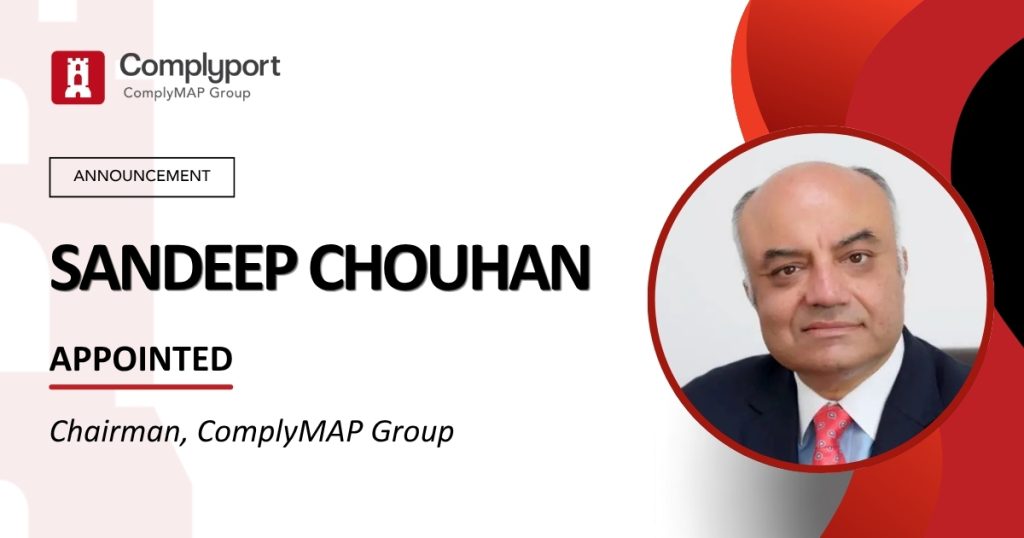
We are pleased to announce the appointment of Sandeep Chouhan as Chairman of ComplyMAP Group, with effect from 1 September 2026. The appointment comes as the UK-based Group, through its flagship global brand, Complyport, enters an important new stage of international expansion and strategic development. Complyport brings together more than 25 years of regulatory, risk, compliance and technology expertise, supported by 250+ industry experts across the UK, Europe, the Middle East, Africa and India. As Chairman of ComplyMAP Group, Sandeep will work closely with Complyport’s leadership team on growing the business and advancing its strategic roadmap: Tech & RegTech Acceleration: Driving technology modernisation, digital transformation and scaling RegTech capabilities, leveraging AI, cloud platforms and analytics to deliver next-generation regulatory solutions. International Growth: Supporting expansion and positioning across key markets, including the Gulf region, India, Africa and beyond. Strategic Relationships: Building and strengthening relationships with major financial institutions, corporates, governments, investors and strategic partners. Senior Representation: Supporting international engagement with senior business leaders, institutions, regulators and other key stakeholders. Sandeep Chouhan brings over 36 years of global operational experience, an extensive international network and a proven track record of driving high-growth agendas across blue-chip financial institutions, digital banks and global payment platforms. Having managed business transformations and technology operations across 33 countries, including roles at Barclays, Citibank, Morgan Stanley, Abu Dhabi Islamic Bank (ADIB) and Network International, Sandeep brings significant expertise in digital innovation, AI-enabled transformation and global platform scaling. Sandeep Chouhan said: “I am delighted to be joining ComplyMAP Group as Chairman at an important point in its development. The Group, via Complyport, has built significant expertise and capabilities, and I believe there is a considerable opportunity to take these into new markets, build major institutional relationships and create substantial long-term value. I look forward to working closely with the team on this next phase of growth.” We look forward to working with Sandeep as we enter this next phase of international growth and strategic development. Interested in discussing a strategic partnership, international opportunity or working with us? Visit www.complyport.com
Moving Beyond Spreadsheets for More Effective AML Compliance
Anti-Money Laundering (AML) controls play a critical role in protecting financial services firms from financial crime, regulatory action and reputational damage. As money laundering methods become increasingly sophisticated, firms need compliance processes that can adapt to evolving risks and regulatory expectations. While spreadsheets have traditionally been used to manage AML activities, they were never designed to support the complexity of modern compliance. As firms grow and regulatory requirements become more demanding, manual processes can become increasingly difficult to manage and control. The Limitations of Spreadsheet-Based AML Compliance The limitations of spreadsheets become particularly apparent when managing the volume and complexity of modern financial transactions. A single spreadsheet may contain thousands of rows of data, making it difficult to identify patterns or anomalies. Formulas often rely on linked cells, creating dependencies that can be disrupted by a single error. As regulations evolve, updating and maintaining multiple spreadsheets also becomes increasingly time-consuming. These limitations can make it more difficult for firms to maintain accurate records, demonstrate effective oversight, and respond quickly to changing risks. The Cost of Manual Processes The human cost of these limitations is significant. AML analysts can spend hours on manual data entry and reconciliation, time that could be better spent on higher-value activities such as investigating suspicious transactions. The risk of error is ever-present, with potentially serious consequences. A missed suspicious transaction could allow criminal activity to continue, while an incorrect report could lead to false positives that waste investigative resources. Growing Regulatory Pressure and Compliance Risks The regulatory landscape adds further pressure. AML regulations are becoming increasingly stringent, with higher fines and more aggressive enforcement. Firms that cannot demonstrate robust AML controls risk not only financial penalties but also reputational damage that can be difficult to recover from. How Complyport Can Help ComplyPortal, Complyport’s compliance management platform, provides a more robust framework for AML compliance: Customisable workflows can be designed to match your firm’s specific AML processes, ensuring consistent application of your policies. The document management system maintains a secure repository for all AML-related documents, from risk assessments to suspicious activity reports. Task assignments and deadlines help ensure that all AML obligations are met on time. An audit trail provides evidence of your compliance efforts to regulators. By replacing disconnected spreadsheets with a structured compliance management platform, firms can improve consistency, strengthen oversight and manage AML obligations with greater confidence. To learn more about how ComplyPortal can help transform your compliance processes, contact our team to book a demo.
AI Governance in UK Financial Services: The Role of Compliance Management Tools

Artificial Intelligence (AI) is transforming how UK financial services firms operate, from customer interactions and financial crime controls to internal decision-making and regulatory reporting. While AI offers significant opportunities to improve efficiency and productivity, it also raises the bar for governance. Firms must be able to demonstrate that AI-enabled processes are appropriately controlled, well-governed and aligned with regulatory expectations. The UK continues to take a principles-based, pro-innovation approach to AI regulation. Rather than introducing a single AI-specific rulebook, regulators generally expect firms to apply existing legal and regulatory frameworks to the use of AI. As the UK’s AI assurance ecosystem continues to evolve, firms should view AI governance as an integral part of operational risk management rather than a standalone technology initiative. AI and UK Regulatory Compliance The UK’s approach to AI governance is built around five core principles designed to promote innovation while managing risk: Safety, security and robustness: AI systems should operate securely and manage risks effectively. Transparency and explainability: AI-driven decisions and outputs should be sufficiently understandable to those who rely on them. Fairness: AI should not discriminate unlawfully or undermine legal rights. Accountability and governance: Clear oversight should exist throughout the AI lifecycle. Contestability and redress: Individuals should have appropriate routes to question or challenge AI-driven decisions where necessary. For regulated firms, these principles translate into a simple test: can you demonstrate that AI is being used in a way that supports good customer outcomes, sound governance and operational resilience? Managing AI Risks in UK Financial Services Firms adopting AI should focus on the risks regulators will expect them to have identified, assessed and controlled in a practical, auditable way. Incorrect or misleading outputs can affect customer communications, internal decision-making and regulatory reporting. Firms should establish clear guardrails, including approved use cases, review processes and escalation procedures. Lack of transparency can make it difficult to explain how AI-generated decisions have been reached. Firms should ensure appropriate oversight and retain the ability for employees to review, challenge and override AI outputs where necessary. Data privacy and security remain critical considerations. AI often relies on large volumes of data and may involve third-party providers. Firms should maintain robust controls over lawful processing, data security, retention and the protection of confidential information. Accountability is equally important. Firms should be able to demonstrate who approved an AI use case, who owns the associated risks, how performance is monitored and how issues are identified and addressed. The Role of Compliance Management Systems As AI adoption grows, so does the need for structured governance, clear documentation and ongoing oversight. Compliance management systems help firms embed these controls into day-to-day operations while reducing manual effort and improving consistency. Effective compliance management platforms support structured risk assessments, monitoring programmes, issue management, document control and comprehensive audit trails. Together, these capabilities help firms demonstrate that AI risks have been identified, assessed and managed appropriately throughout the lifecycle of each use case. Rather than relying on one-off approvals, firms can maintain ongoing oversight and generate the evidence needed to demonstrate effective governance. This is where modern compliance management platforms, such as ComplyPortal, help organisations embed governance into their day-to-day compliance processes while maintaining a clear evidential record. Putting AI Governance into Practice AI offers significant opportunities for financial services firms, but its success depends on more than adopting new technology. Firms need governance frameworks that provide clear accountability, effective oversight and confidence that AI is being used responsibly. By embedding AI governance into everyday compliance and risk management, organisations can embrace innovation with greater confidence, respond more effectively to evolving regulatory expectations, and demonstrate that AI is delivering positive outcomes for both the business and its customers. How Complyport Can Help Embedding AI governance into everyday compliance activities is easier with the right technology. ComplyPortal, Complyport’s Compliance Monitoring and Learning Solution, helps firms strengthen governance, maintain oversight and evidence compliance through: Centralised Documentation and Reporting: Secure storage for policies, procedures and GDPR documentation, with the ability to distribute updates for employee attestation. Expert-Built Regulatory Templates: An extensive library of templates aligned with current FCA and PRA requirements, maintained by our consultancy team to reflect changes to the FCA Handbook without requiring manual intervention from your team. Compliance Monitoring: Early detection of compliance issues to help reduce the risk of regulatory breaches and enforcement action. Custom Reports and Audit Trails: Transparent reporting with exportable audit trails to support regulatory reviews and demonstrate compliance. Integrated Risk Assessment Module: Identify, assess and manage risks through a structured framework aligned with SYSC requirements. By centralising compliance activities and creating a clear evidential record, ComplyPortal helps firms manage AI governance with greater confidence while strengthening their overall compliance framework. To learn more about how ComplyPortal can transform your compliance processes, contact our team to book a demo.
Consumer Duty: Why Manual Compliance Creates Hidden Risks
The Financial Conduct Authority’s (FCA) Consumer Duty represents a significant shift in how financial services firms are expected to support their customers. Firms are no longer expected simply to avoid causing harm; they must be able to demonstrate that they are delivering good outcomes for retail customers throughout the customer journey. Meeting this higher standard requires firms to monitor customer outcomes consistently, identify emerging risks and take appropriate action when issues arise. For firms that continue to rely heavily on manual processes, this can present a significant challenge. Manual compliance processes can create blind spots. When customer information is spread across multiple systems, spreadsheets and paper-based records, it becomes more difficult to identify vulnerabilities, monitor customer outcomes and recognise emerging patterns. A customer experiencing financial difficulties may not receive the support they need if key information is not captured or shared effectively. Similarly, products or services that repeatedly lead to poor outcomes may be harder to identify when information is fragmented across different teams and systems. The consequences of these oversights can be significant. Customers may not receive the support they need, while firms face increased regulatory scrutiny and the risk of failing to meet Consumer Duty expectations. The FCA has made it clear that firms should be able to evidence how they monitor, assess and improve customer outcomes over time. The solution is not to replace human judgement, but to support it with stronger processes and technology. Digital compliance systems can help firms maintain consistent records, identify potential issues earlier and gain greater visibility across customer interactions and outcomes. This enables compliance teams to take a more proactive approach and respond more effectively as risks emerge. How Complyport Can Help ComplyPortal, a technology platform by Complyport, provides firms with the structure they need to support their Consumer Duty obligations. Key capabilities include: Customisable workflows to support the consistent monitoring and assessment of customer outcomes. Centralised document management to maintain clear records of customer interactions, decisions and supporting evidence. Task management and automated reminders to help ensure that actions are completed on time and responsibilities are clearly assigned. Comprehensive audit trails that provide clear visibility of decisions, actions and outcome-monitoring activities. By bringing information, processes and oversight together in one platform, ComplyPortal helps firms move from reactive compliance towards a more proactive approach to Consumer Duty. To learn more about how ComplyPortal can help strengthen your Consumer Duty compliance processes, contact our team to book a demo.
UK EMIR Reporting: Complete Guide to UK EMIR Refit Reporting Requirements in 2026
UK EMIR Reporting Explained The UK’s version of the European Market Infrastructure Regulation (EMIR) is a framework designed to increase transparency in the over-the-counter (OTC) derivatives market and reduce systemic risk across financial markets. EMIR requires counterparties trading derivative contracts to report details of those trades to authorised trade repositories. The regulation applies to both exchange-traded and OTC derivatives and remains one of the most important reporting obligations for firms established in the UK. Following the introduction of EMIR Refit, reporting requirements have become more detailed, with firms expected to submit significantly larger datasets and maintain stronger data quality controls. For many firms, achieving accurate and timely reporting has become increasingly challenging, making specialist reporting technology essential. What Is UK EMIR? UK EMIR was introduced in response to commitments made by the G-20 countries in the aftermath of the global financial crisis. Its objectives are to: Increase transparency in derivatives markets Reduce counterparty credit risk Improve market oversight Support financial stability EMIR includes requirements relating to: Clearing obligations for certain derivatives Timely confirmations Exchange of Collateral Collateral quality and quantities Post Trade Risk Reduction exercises – portfolio compression Valuations of outstanding positions The reporting obligation espoused under UK EMIR is meant to demonstrate that counterparties to derivative contracts comply with the abovementioned obligations, as well as provide the FCA with an overview of market activity in the OTC space. EU EMIR and UK EMIR Following the UK’s departure from the European Union in 2020, the UK onshored many rules inherited from its EU membership. EMIR is one of those rules. At their core, both EU and UK EMIR rules are very similar; however, as time progressed, the two rulesets began to deviate. This is more pronounced on the EU side with the introduction of “EMIR 3” amending EMIR, which created additional requirements regarding authorisation of initial margin models, validation of proforma models, as well as the CCP active account requirements. Additionally, the FCA and the BoE have provided level 3 guidance to UK reporting entities, which in some cases may differ from guidance provided by ESMA. In addition, the FCA applies different validation rules for its own EMIR reporting requirements. Therefore, UK entities with an EU footprint (or EU firms with a UK footprint) must not presume that the two rulesets are the same. What Is UK EMIR Refit? EMIR Refit is a major update to the original EMIR reporting framework. The reforms were introduced to improve: Data consistency Reporting accuracy Cross-border regulatory alignment Trade repository data quality Regulatory oversight EMIR Refit aligns reporting standards more closely with global frameworks developed by CPMI-IOSCO and introduces ISO 20022 reporting standards. The number of reportable fields increased significantly, requiring firms to capture and validate much more detailed information about derivative transactions. Who Must Report Under UK EMIR? EMIR obligations apply to a wide range of market participants. Financial Counterparties (FCs) Examples include: Investment firms Credit institutions Insurance companies UCITS Alternative Investment Funds Pension scheme arrangements Non-Financial Counterparties (NFCs) Undertakings established in the UK that enter into derivative trades. Which Financial Instruments are Captured? All Financial Instruments specified under points (4) to (10) of Part 1 of Schedule 2 to the Financial Services and Markets Act 2000 (Regulated Activities) Order 2001. Both OTC and exchange-traded derivatives are generally reportable. UK EMIR Reporting Deadlines Firms must report derivative transactions no later than the next working day – T+1. This means details must be submitted by the end of T+1 following: Trade execution Modification Valuation updates Collateral updates Lifecycle Events such as: Exercising of Options (if exercised before maturity) Novation Corporate Actions Credit Events Terminations Failure to meet reporting deadlines can result in regulatory scrutiny and enforcement action. Key UK EMIR Refit Data Fields EMIR Refit introduced over 200 reportable data fields. Important data elements include: Unique Transaction Identifier (UTI) The UTI uniquely identifies a transaction and allows regulators to match reports submitted by both counterparties. The UTI construction is harmonised at a global level by ISO 23897. Unique Product Identifier (UPI) The UPI identifies the derivative product being traded. The UPI is harmonised at a global level by ISO 4914:2021 and the issuance and maintenance of the UPI codes are assigned to the Derivatives Service Bureau. Granular derivative details EMIR Refit introduced additional data points that offer a more granular overview of each derivative contract’s mechanics such as: Crypto asset flags Derivative Direction distinctions: Payer/Receiver e.g. swaps Buyer/Seller e.g. futures Report Triggering Event flags e.g. New Trade Exercising Allocations Step-in events Schedules, where the contract contains throughout its lifecycle different parameters such as: prices quantities notional amounts Collateralisation details EMIR Refit expanded the collateralisation categories to provide a clearer view to competent authorities regarding which counterparty is liable to post/receive collateral, as well as the type of collateral posted/received (initial or variation margins or both). Collateral haircuts EMIR Refit introduced the concept of collateral haircuts whereby counterparties report in detail the nominal amount of collateral received/posted and the amount of the same collateral post haircut applications (subject to internal risk management processes). Common EMIR Reporting Challenges Many firms struggle with: Data Quality Issues Inconsistent source data often leads to: Rejections Pairing failures Reconciliation breaks UTI Management Generating and exchanging UTIs within required timeframes remains a challenge for many counterparties. Reconciliation Failures Trade repositories compare submissions from both sides of a transaction. Differences can trigger regulatory concern. Legacy Systems Older reporting systems often struggle to support ISO 20022 data standards and EMIR Refit requirements. EMIR Reporting Penalties and Regulatory Expectations Regulators expect firms to maintain: Accurate reporting processes Data governance frameworks Reconciliation controls Error correction procedures Management oversight The FCA has repeatedly highlighted data quality as a supervisory priority, such as Market Watch 84. Firms should regularly review: Reporting completeness Data accuracy Trade repository feedback Exception management processes Delegated Reporting Under EMIR Many firms choose delegated reporting arrangements to reduce operational burden. Under delegated reporting: A service provider submits reports on behalf of the counterparty. The reporting obligation may be operationally delegated. Regulatory responsibility
Senior Managers and Certification Regime: Why Paper-Based Processes Create Unnecessary Risk
The Senior Managers and Certification Regime (SM&CR) was introduced to strengthen accountability across financial services. At its core is a simple principle: firms must be able to demonstrate who is responsible for key decisions and activities, and senior managers must be able to show they have taken reasonable steps to discharge their responsibilities. While the principle is straightforward, maintaining effective accountability in practice can be challenging. Responsibilities evolve, reporting lines change, regulatory requirements develop, and employees move between roles. For firms that continue to rely on paper records, spreadsheets and manual processes, keeping pace with these changes can become increasingly difficult. The limitations of paper become particularly apparent when considering the dynamic nature of financial services. Responsibilities change, new regulations are introduced, and staff move between roles. Keeping track of all this manually is not only time-consuming but error-prone. A handwritten note about a change in responsibilities can be lost, a signature can be missed, and before you know it, there are gaps in your accountability framework. The stakes are high. Under SM&CR, senior managers can be held personally accountable for failures in their areas. This means that incomplete or inaccurate records aren’t just a compliance issue; they can have serious personal consequences for individuals. The regime also requires firms to maintain a Single Directory of all certified staff, which becomes increasingly difficult to manage manually as organisations grow. The digital age demands digital solutions. Firms need systems that can keep pace with change, provide clear audit trails, and give regulators confidence in their accountability frameworks. How Complyport Can Help ComplyPortal, Complyport’s Compliance Management System, transforms SM&CR from a bureaucratic burden into a manageable process. The document management feature provides a secure, centralised repository for all Statements of Responsibilities, Management Responsibilities Maps and handover records. Task assignments ensure that certifications are renewed on time, while the audit trail functionality provides the transparency that regulators require. This digital approach not only meets regulatory requirements but also gives senior managers peace of mind that their accountability is properly documented. For more information on how ComplyPortal can transform your compliance processes, please get in touch with our team to book a demo.
EU EMIR Reporting: Complete Guide to EU EMIR Refit Reporting Requirements in 2026
The European Market Infrastructure Regulation (EMIR) is a regulatory framework designed to increase transparency in the over-the-counter (OTC) derivatives market and reduce systemic risk across financial markets. EMIR requires counterparties trading derivative contracts to report details of those trades to authorised trade repositories. The regulation applies to both exchange-traded and OTC derivatives and remains one of the most important reporting obligations for firms established in the EU. Following the introduction of EMIR Refit, reporting requirements have become more detailed, with firms expected to submit significantly larger datasets and maintain stronger data quality controls. For many firms, achieving accurate and timely reporting has become increasingly challenging, making specialist reporting technology essential. What Is EMIR? EMIR was introduced in response to commitments made by the G-20 countries in the aftermath of the global financial crisis. Its primary objectives are: Increase transparency in derivatives markets Reduce counterparty credit risk Improve market oversight Support financial stability EMIR includes requirements relating to: Clearing obligations for certain derivatives Timely confirmations Exchange of Collateral Collateral quality and quantities Post Trade Risk Reduction exercises – portfolio compression Valuations of outstanding positions The reporting obligation espoused under EU EMIR is meant to demonstrate that counterparties to derivative contracts comply with the abovementioned obligations, as well as provide the relevant authorities with an overview of market activity in the OTC space. EU EMIR and UK EMIR Following the UK’s departure from the European Union in 2020, the UK onshored many rules inherited from its EU membership. EMIR is one of those rules. At their core, both EU and UK EMIR rules are very similar; however, as time progressed, the two rulesets have begun to deviate. This is more pronounced on the EU side with the introduction of “EMIR 3” amending EMIR, which created additional requirements regarding: Authorisation of initial margin models Validation of proforma models CCP active account requirements Additionally, the FCA and the Bank of England (BoE) have provided level 3 guidance to UK reporting entities, which in some cases may differ from guidance provided by ESMA. In addition, the FCA applies different validation rules for its own EMIR reporting requirements. Important Regulatory Note: UK entities with an EU footprint (or EU firms with a UK footprint) must not presume that the two rulesets are the same. What Is EMIR Refit? EMIR Refit is a major update to the original EMIR reporting framework. The reforms were introduced to improve: Data consistency Reporting accuracy Cross-border alignment Repository data quality Regulatory oversight EMIR Refit aligns reporting standards more closely with global frameworks developed by CPMI-IOSCO and introduces ISO 20022 reporting standards. The number of reportable fields increased significantly, requiring firms to capture and validate much more detailed information about derivative transactions. Who Must Report Under EMIR? EMIR obligations apply to a wide range of market participants across both sectors: Financial Counterparties (FCs) Key examples include: Investment firms Credit institutions Insurance companies UCITS & Management Companies Alternative Investment Funds (AIFs) Pension scheme arrangements Non-Financial Counterparties (NFCs) Undertakings established in the EU that enter into derivative contracts, categorised depending on whether they exceed designated clearing thresholds (NFC+ / NFC-). Which Financial Instruments are Captured? All Financial Instruments specified under points (4) to (10) of Section C of the MiFID Directive. Both OTC and exchange-traded derivatives (ETDs) are universally reportable under the scope. EMIR Reporting Deadlines Strict Statutory Timeline Firms must report derivative transactions no later than the next working day. T+1 Deadline Details must be submitted by the end of T+1 following: ✔ Trade execution ✔ Modification ✔ Valuation updates ✔ Collateral updates ✔ Terminations Lifecycle Events triggered under T+1 include: • Exercising of Options • Novation • Corporate Actions • Credit Events, etc. Failure to meet reporting deadlines can result in prompt regulatory scrutiny, supervisory audits, and formal enforcement action. Key EMIR Refit Data Fields EMIR Refit introduced over 200 reportable data fields. Key data elements include: ISO 23897 Unique Transaction Identifier (UTI) The UTI uniquely identifies a transaction and allows regulators to match reports submitted by both counterparties. The UTI construction is harmonised globally. ISO 4914:2021 Unique Product Identifier (UPI) Identifies the derivative product being traded. Issuance and maintenance of UPI codes are assigned internationally to the Derivatives Service Bureau (DSB). Granular Derivative Details Captures mechanics such as Crypto Asset flags, Direction distinctions (Payer/Receiver for swaps, Buyer/Seller for futures), and triggering events (New Trade, Step-in, Allocations). Contract Schedules Allows granular tracking where the contract espouses different parameters throughout its lifecycle, including changing prices, quantities, and notional amounts. Collateralisation Details Expanded categories provide clear visibility into which counterparty is liable to post/receive collateral, specifying initial margins, variation margins, or both. Collateral Haircuts Requires counterparties to report in detail the nominal collateral posted/received vs the collateral value post-haircut application (aligned with risk policies). Common EMIR Reporting Challenges Many firms consistently struggle with the heightened operational demands of EMIR Refit: Data Quality Issues Inconsistent or fragmented source data leads to recurring Trade Repository rejections, pairing failures, and reconciliation breaks. UTI Management Generating, agreeing upon, and exchanging UTIs with counterparties within the tight T+1 timeframe remains an ongoing bottleneck. Reconciliation Failures Trade repositories pair submissions from both sides. Any valuation, collateral, or field mismatch triggers regulatory inquiry. Legacy Systems Older architectures struggle to natively parse ISO 20022 XML formats and manage the expanded 200+ field dataset. EMIR Reporting Penalties & Regulatory Expectations National competent authorities (NCAs) have repeatedly highlighted data quality as a foremost supervisory priority. Regulators expect firms to strictly maintain: Accurate reporting processes Robust data governance frameworks Active reconciliation controls Documented error correction procedures Continuous senior management oversight To avoid enforcement measures, firms should regularly review: Reporting completeness & audit logs Field-level data accuracy Trade repository warning/rejection feedback Exception management & escalation procedures Delegated Reporting Under EMIR Many counterparties opt for delegated reporting arrangements to mitigate operational and technological overhead. Operational Delegation vs. Regulatory Liability: While operational submission may be delegated to a dealer or third-party service provider, legal and regulatory responsibility strictly remains with the reporting entity. Ongoing oversight and regular