
Key Points from ESMA’s EMIR & SFTR Data Quality Review

For the first time, ESMA has published a Data Quality Report (DQR) to gauge the quality of the data reported to Trade Repositories (TRs) under both EMIR and SFTR. The main objectives of these reporting regimes are to increase transparency in the derivatives and Securities Financing Transaction (SFT) markets and boost the ability of European authorities to monitor systemic and financial stability risks. This DQR aims to provide an overview of the current state of play under the two reporting regimes, while also providing insights into the ongoing efforts made by National Competent Authorities (NCAs) and ESMA to improve data quality. EMIR Reporting Trends and Data Quality Key trends in data reporting In the DQR, ESMA presented the key trends for 2020, showing how both the COVID-19 pandemic and Brexit impacted EMIR reporting trends through increased market volatility and volume shifts. Examining submissions by contract type, ESMA identified that there was a significant decline in the number of Futures contracts reported. In contrast, CFDs and Options almost doubled in volume. Concerning the data inflation issues, ESMA monitored the accuracy of TR regulatory reports. Several issues were identified, which led an increase in the number of open contracts. For instance, ESMA identified how misreporting by a single EU counterparty inflated the number of reports. Furthermore, ESMA highlighted how crucial it is for the counterparties to report in line with its regulatory expectations and that misreporting could undermine the economic and financial stability analysis performed by data users. Data completeness, timeliness and availability The DQR has revealed many issues in the data and presented some of the findings the NCAs discovered during their reviews and investigations. Below we highlight those areas market participants and NCAs should focus on when assessing data completeness, timeliness and availability: Coordinated Universal Time (UTC) is not converted to local time. This leads to records being wrongly classified as “Late Reporting” due to UTC vs. local time discrepancies. An increase in late reporting with around 7% of daily submissions arriving late in early 2021. Non-reported derivatives (derivatives that should have been reported to a TR by EU counterparties but were not). Non-reporting of valuations, with a significant portion of open derivatives subject to daily valuations, either did not receive updates for several years or had valuation timestamps in the future. Data accuracy and adhering to format and content Based on the rejection statistics provided by TRs, a low rejection rate was identified, dropping to 12% from a peak of 40%. At the same time, the average number or errors per submission was 2. More specifically, the fields that most commonly failed the validation process were the strike price, strike price notation, underlying identification type, fixed and floating rate, collateral portfolio and commodity details. Data integrity and reconciliation The need to reconcile the data stems from the dual-sided reporting obligation. As such, data reconciliation is one of the key processes by which to assess data quality under EMIR. This process is split into two distinct phases: pairing and matching. ESMA highlighted that, historically, the pairing was problematic. Although it increased by the end of 2020, it remained very low considering that successful pairing requires counterparty agreement on only three fields (reporting counterparty ID, ID of the other counterparty, and trade ID). ESMA underlined several reasons for the lack of pairing, including non-reporting, disagreement on the generation of trade ID, or the position vs. trade level reporting. Furthermore, given that both counterparties are expected to agree on the details to be reported to TRs for reconciliation purposes, ESMA anticipated that the number of derivatives reported from both counterparties would be the same. Nevertheless, this was not the case, as this was inhibited by the lack of agreement on fundamental aspects such as the number of derivatives that were concluded with each other. SFTR Reporting Trends and Data Quality Due to the relatively short time since reporting went live, the DQR focused primarily on providing an initial overview of the data reporting landscape and TR rejection rates for counterparty submissions. While the TR rejection rate was elevated in the initial weeks after reporting came into effect, it has declined significantly since then, which indicates that TRs and counterparties are becoming increasingly familiar with the reporting process. Reporting of SFTs showed an increasing trend since Brexit, when there was a steep drop in the number of reporting counterparties. The vast majority of reported SFTs were securities lending and borrowing transactions and repurchase agreements where 90% of them were reported by investment firms and credit institutions.
CRS and FATCA Reporting Obligation Is Fast Approaching! Are You Ready?
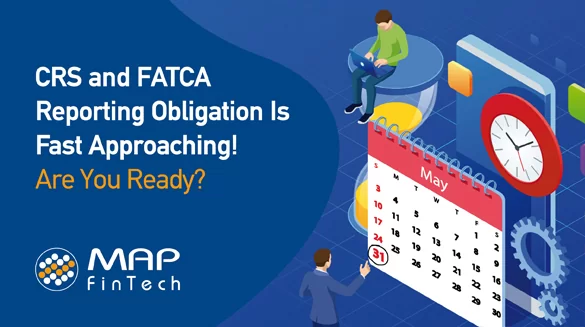
The clock is ticking for FATCA and CRS annual submissions, as the reporting deadline to the relevant Tax Authorities is set between end of May and July, for most participating jurisdictions. The reporting deadlines for a number of jurisdictions are provided below: CRS and FATCA Reporting Requirements The Common Reporting Standard (CRS) requires financial institutions to report annually to their local tax authorities information on their clients that are tax residents of other participating jurisdictions to be passed on to the relevant tax authorities. The Foreign Account Tax Compliance Act (FATCA) requires financial institutions to report annually to their local tax authorities information on their USA clients to be passed on to the US tax administration. Challenges & Risks Firms face a number of challenges and risks that need to be addressed in order to proceed with the pertinent submissions before the deadline: Challenges: Analysis and interpretation of the requirements, which consist of over 300 pages of guidelines to read. More than 65 fields per record to complete. Complicated multilevel XML files. Different jurisdictions with each posing a different set of challenges. Risks: Incorrect completion of CRS and FATCA submissions. Failure to meet the reporting deadline and overall requirements. Costly investment in resources to help you file the relevant submissions, which in turn may place a burden on your budget. Disruption of your daily operations. Incorrect or false submissions that may result in a withholding penalty to specific payments. How can Complyport Tech assist you? Complyport Tech can fully support your business’ regulatory reporting needs. We receive reportable information, construct the CRS and FATCA annual reports, and, for most countries, submit them to the relevant competent authority as prescribed by the relevant provisions of CRS and FATCA. ΜΑΡ FinTech’s CRS and FATCA Reporting Services provide a user-friendly approach to receiving, validating, transforming and submitting the relevant information required under the CRS/FATCA reporting and due diligence rules. These services are delivered via our powerful and award winning Polaris platform, together with the rest of its reporting offerings and our team of experts’ impeccable support services. ΜΑΡ FinTech’s CRS/FATCA – Key Features Cost-efficient integrated reporting solutions provided under a single platform. Highly automated and scalable solution that can report as many accounts as you have. Flexible in the way it receives data, either via standard templates or raw data. Multiple reporting health checks for both content and schema and automatic filtering of erroneous entries. Automatic conversion of data to XML and separation of files based on tax residency. Submissions to various tax authorities worldwide. On-going communication with regulators to ensure the system reports reflect regulatory updates and changes.
ESMA published its Final Report on the review of transaction and reference data reporting obligations under MiFIR
Regulatory Alert! Earlier this week, ESMA published its Final Report on the review of transaction and reference data reporting obligations under MiFIR. The Final Report builds on ESMA’s Consultation on MiFIR transaction reporting published on the 24th of September 2020 (see https://complyporttech.com/regulatory-alert-important-changes-to-mifir-reporting-proposed-by-esma/). According to ESMA, the Final Report contains recommendations and possible legislative amendments to MiFID II/MiFIR with a view to simplifying the current reporting regimes whilst ensuring quality and usability of the reported data. It aims to achieve this through: The replacement of the TOTV concept with the SI approach for OTC derivatives, taking into account the conclusions of ESMA’s Final Report on the transparency regime for non-equity instruments and the trading obligation for derivatives; The removal of the short sale indicator; The alignment with reporting regimes such as MAR, EMIR and the Benchmark Regulation; The reliance on international standards, including LEIs, ISINs and CFIs; and The inclusion of three additional data elements with a view to harmonise the way they are reported and avoid inconsistent and duplicative reporting of the same information at the national level. In particular, these are indicators for: Buyback programs; Information on MiFID II client categories; and Transactions pertaining to aggregated orders. ESMA’s recommendations are particularly relevant for trading venues, systematic internalisers, investment firms, data reporting services providers, and asset management companies. The Final Report will be submitted to the European Commission and is expected to feed into any review of the transaction reporting regime in MiFIR. The Final Report can be accessed here.
Complyport Tech Named as One of the Most Influential Financial Technology Companies for 2021

Financial Technology Magazine has released its latest edition today, revealing the full list of The Most Influential Financial Technology Companies of 2021, as judged by an expert panel. We are very honoured to be included in this group of innovative organisations that are driving change in the financial services industry! In this edition, an article titled “The symbiotic relationship between compliance and tech” by Mark Ellis, UK Business Development Manager of Complyport Tech is also featured. Read full article below
Recent regulatory updates: EU and UK RTS27 reliefs and UK EMIR updates

The past few weeks have been busy with several regulatory updates across the EU and the UK. Some noteworthy changes are presented below: EU temporary relief from RTS 27 reporting Last month, the European Parliament and the EU Council published Directive (EU) 2021/338, amending MiFID II to help recovery from the COVID-19 pandemic. The Directive is coined by industry circles as the MiFID II ‘Quick-Fix’ Directive. The MiFID II ‘Quick-Fix’ Directive amends MiFID II, inter alia, by adding the following subparagraph in Article 27(3) ‘The periodic reporting requirement to the public laid down in this paragraph shall not apply until 28 February 2023. The Commission shall comprehensively review the adequacy of the reporting requirements laid down in this paragraph and submit a report to the European Parliament and the Council by 28 February 2022.’ Member States are expected to adopt and publish by 28 November 2021 the laws, regulations and administrative provisions necessary to comply with the MiFID II ‘Quick-Fix’ Directive. The measures introduced by MiFID II ‘Quick-Fix’ Directive shall apply from 28 February 2022. There is a good chance that Member States will proceed to temporary relieve firms from RTS 27 reporting before formal transposition of the MiFID II ‘Quick-Fix’ Directive into local laws considering also last year’s relevant regulatory forbearance that ESMA published, but this still remains to be seen. FCA supervisory flexibility on RTS 27 reporting Last week, the FCA published a statement specifying that they are putting in place temporary measures with respect to RTS 27 reports while they consult on changes to these requirements later this Spring. Specifically, the FCA will not be taking action against firms who do not produce RTS 27 reports for the rest of 2021. FCA updates its UK EMIR validation rules On another development, last week, the FCA has updated its validation rules for UK EMIR. The update concerns field 1.30 Variation Margin Received where the requirement to leave blank the said field if the Collateralisation field is populated with ‘U’ (Uncollateralised) has now been removed. The amendment will apply from 21st June 2021.
RTS 27/28 Reporting Obligation Is Fast Approaching! Are You Ready?

The reporting deadline of RTS 27 and RTS 28 submissions for several participating jurisdictions is drawing near, as it is set for 31st March and 30th April 2021 respectively. RTS 27 & RTS 28 Reporting Requirements RTS 27 requires execution venues, market makers and systematic internalises to publish reports with their transaction data. These reports must be published on a quarterly basis and include data for each trading day. Publication must be made in a machine-readable format at the end of each quarter for the previous quarter. RTS 28 requires investment firms to publish, by 30 April of each year, a summarised annual information report of the quality of execution and disclosure of their top 5 execution venues. How can Complyport Tech assist you? Complyport Tech can fully support your business’ regulatory reporting needs. ΜΑΡ FinTech’s RTS 27/28 Reporting Service helps clients map all compulsory data to the format required by the Commission Delegated Regulation (EU) 2017/575 and 2017/576, producing the relevant report and making it available to the customer through our Polaris Portal in a machine-readable electronic format. This service is delivered via our powerful and award winning Polaris platform, together with the rest of its reporting offerings and our team of experts’ impeccable support services. ΜΑΡ FinTech RTS 27/28 – Key Features Fully automated service Retrieves information from any system and/or database Consolidated data feeds Comprehensive field, data and entity mapping capability Recognition of information to be reported Multiple reporting health checks Efficient generation of all required RTS 27/28 tables Flexibility to adapt to your customised needs On-going communication with regulators to ensure system reports reflect regulatory updates and/or changes
Vote for Complyport Tech at A-Team Group’s RegTech Insight Awards 2021

We are excited to announce that Complyport Tech has been shortlisted in 3 categories in A-Team Group’s RegTech Insight Awards for 2021! RegTech Insight Awards – Europe recognize both established solution providers and innovative newcomers that are seeking to indicate and highlight RegTech solutions that have successfully improved firms’ ability to effectively respond to the evolving and ever more complex regulatory requirements across the global financial services industry throughout the year. Please take a moment to support Complyport Tech by giving your vote. Complyport Tech has been shortlisted in the following categories: Best Compliance as a Service Solution (category 26) Best Regulatory Reporting Solution (category 29) Best Innovative Technology for Regulatory Compliance for our Polaris Platform (category 31) The last day to vote is: 18 March 2021 We would be thankful to have your support!
Complyport Tech named as one of the leading vendors in annual RegTech Buyer’s guide

Complyport Tech Global and RegTech Analyst, named Complyport Tech as one of the 45 leading vendors in its annual RegTech Buyer’s guide. The guide provides financial institutions, with information about the global RegTech market and its supplier ecosystem. Click to access the full RegTech Buyer’s Guide and learn more about the latest RegTech trends and offerings, with in-depth analysis and opinions set by experts in the field. About Complyport Tech Complyport Tech is a leading award-winning UK and EU regulatory technology provider for the financial services industry, specialising in reporting solutions arising from the requirements of a number of complex and challenging international regulations such as EMIR, MiFID II/MiFIR, ASIC, SFTR, FATCA, DAC6 and CRS. Complyport Tech also provides innovative and comprehensive solutions for Best Execution Monitoring, RTS 27/28 reporting, AI-Enabled AML Transaction Monitoring and Screening, Trade Surveillance (Market Abuse), and eKYC (Screening, eIDV, Document Authentication). Complyport Tech, has been one of the First providers in Europe to have reported under European Market Infrastructure Regulation (EMIR) with 2 Billion+ transactions successfully reported thus far since February 2014. We currently serve over 180 B2B global clients and have been recognised as having the Best RegTech Reporting Solution for 2019 by Finance Magnates London and named as one of the 100 most innovative RegTech companies in the world for 2020 and 2021 by RegTech Analyst.
ESMA publishes draft Technical Standards under EMIR REFIT

Brief Summary ESMA has recently published its Final Report on the technical standards (RTS and ITS) under the EMIR REFIT regulation. The Report focuses on further harmonisation of the reporting requirements as well as enhancements in the counterparties and Trade Repositories (TRs) procedures on ensuring data quality, following consultation with the market. The Final Report complements the technical standards on reporting requirements, procedures to reconcile and validate data, to the technical standards on registration and access by the relevant authorities under EMIR REFIT. The key elements in the Final Report covers issues relating to the reporting of counterparties to TRs, the data collection from TRs, the update of a LEI and reconciliation of data, the responses of TRs to reporting counterparties, the entities responsible for reporting and submitting entities, the registration of TRs and proposals regarding the terms and conditions of data access by the authorities. Furthermore, the key proposals included in the technical standards, focus on the alignment with the international standards on the definition, format and usage of key OTC derivatives data elements reported to TRs, the end-to-end reporting in ISO 20022 XML as a single standard for eliminating the risk of discrepancies due to inconsistent data, the harmonised data quality requirements across TRs and the standardised process for data access. In this brief summary we will mainly focus on the proposals and the feedback regarding the reporting by the counterparties to TRs and have an overview on what is included in the technical standards. Regarding counterparties reporting, the Final Report focuses on the methods and arrangements that counterparties should have in place to notify the competent authorities about errors and omissions in the reports, as well as methods and arrangements to ensure resolution of reconciliation failures and correct reporting under the new EMIR REFIT. In addition, it involves provisions on the allocation of responsibility for reporting. For meeting the above, reporting counterparties should at minimum, notify their National Competent Authority (NCA) if they experience a problem that prevents them from submitting their reports to TRs. ESMA also introduced the requirement for counterparties to put in place written procedures, ensuring resolution of all reconciliation breaks. For defining the party responsible for generating the UTI, ESMA proposed some adaptations to the current waterfall approach to align it with the UTI guidance, limiting to a minimum the cases where the counterparties need to agree. UTI guidance will also be followed for the structure of the UTI, which specifies it as a concatenation of the LEI of the generating entity and a unique value created by that entity. Regarding the use of UPI, ESMA decided that all derivatives admitted to trading or traded on a trading venue or a systematic internaliser would need to be identified with ISIN (only), whereas all remaining derivatives would need to be identified with UPI (only). UPI guidance provide that each UPI code would map to a set of data comprised of reference data elements with specific values that together describe the product. In addition, it details proposed changes in the reporting logic, particularly the revised approach for reporting lifecycle events and reporting at position level, as well as presenting an overview of the updated list of details of the derivatives to be reported. Next Steps The draft technical standards have been submitted to the European Commission for endorsement, and the proposed timeline for implementation of the technical standards by the reporting counterparties and TRs in the Union is 18 months from the date of their publication in the Official Journal. In the meantime, ESMA will commence working on the guidelines on reporting under EMIR REFIT as well as on the technical documentation, including XML schemas and validation rules. ESMA aims to provide the industry with the relevant guidance and documentation sufficiently ahead of the reporting start date to ensure a smooth transition to the reporting under the revised rules. What Reporting Counterparties Should Do? Once the relevant technical guidance (guidelines on reporting and accompanying validation rules and ISO 20022 messages) is finalised, reporting counterparties should start working towards the implementation on their reporting. It is envisaged that such documentation should be available approximately 12 months ahead of the reporting start date. Reporting counterparties should nevertheless take into consideration all the changes proposed in the Final Report to assess what changes can affect them and take steps in a timely manner, in order to better prepare and be ready well before their application. How Can Complyport Tech Assist You? At Complyport Tech we simplify your regulatory reporting obligation. Through our powerful Polaris platform, we automate this complex process and we effectively investigate, validate and manage your data. At the same time, our team of specialists provide training throughout the implementation process to ensure that key personnel understand the regulation and process. Our service includes the technology and the consulting from our experts to provide your firm with a single solution for all asset classes across EMIR jurisdictions. You can learn more about Complyport Tech’s EMIR Reporting Solution here. As always, Complyport Tech is at the forefront of developments and stands ready to assist regulated entities to meet their reporting needs with innovative, efficient and robust solutions. For more information please feel free to contact us.
Complyport Tech 2020 In Revıew
2020 has been a challenging, yet exciting year for Complyport Tech! Over the past year, we have achieved a series of significant milestones that we wish to share with you as we begin 2021. Check out our video! We would also like to thank all our valued clients and partners for their continuous support and trust over the years! Complyport Tech team will continue with the same commitment in 2021, to provide best-in-class technology and innovative RegTech solutions that enable our clients to meet their regulatory reporting requirements and achieve best results! We look forward to another successful and productive year ahead!