
Complyport Tech’s Regulatory Analyst, Andreas Savoullis has been invited to speak at the Cyprus Gaming Show 2021.
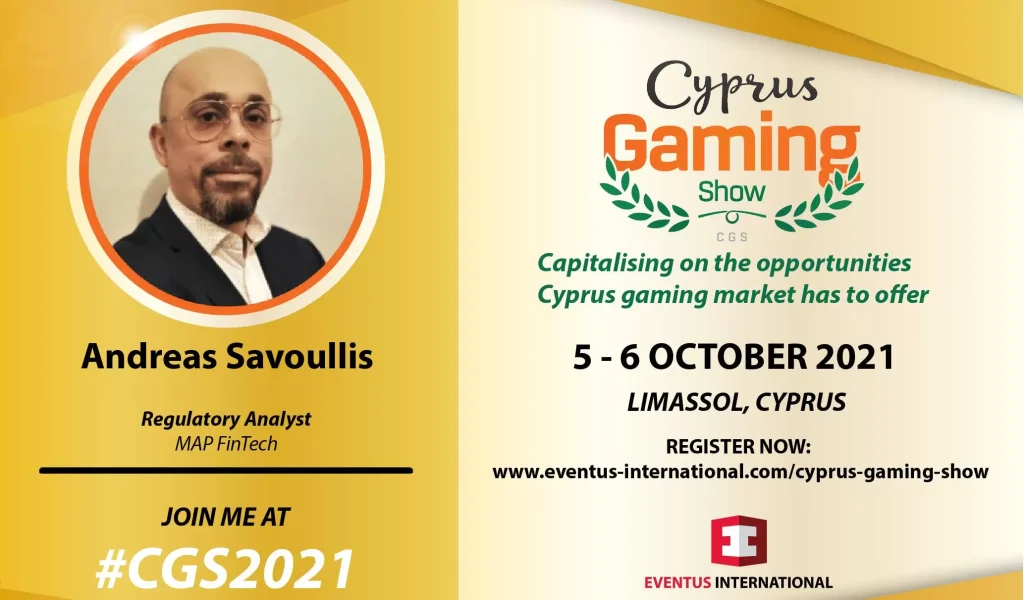
The 4th Annual Cyprus Gaming Show (CGS) will take place from 5-6 October 2021 at Crowne Plaza in Limassol. CGS 2021 will focus on how gaming companies can maximise their growth potential, explore the innovations and progress made in the industry, and take stock of the rapidly changing regulatory landscape as well as the challenges and opportunities in the industry. CGS 2021 offers the opportunity to network and establish valuable business connections, gain a better understanding of best practices, the latest technological innovations, and latest products and services in the industry. All presented to you by industry leaders through an extensive conference programme. Our Regulatory Analyst, Andreas Savoullis has been invited to participate at the CGS and deliver a keynote speech/presentation about “KYC: What can your company do to stay competitive & in compliance in 2021?”. To find more information on the highly anticipated Cyprus Gaming Show 2021 please click here. If you are interested in attending Cyprus Gaming Show 2021 register here.
Limited Time Offer
Leverage the power of RegTech Secure your Best Execution Monıtorıng Solution wıth MAP FinTech in September and take advantage of our offer Complyport.tech offers a fully automated tool for Best Execution Monitoring. The platform not only satisfies the requirements of financial regulators and MIFID II, but also offers a holistic view of your Best Execution provisions with more than 40 analytical checks applied on all execution components (price, cost, speed, likelihood and settlement, size, price continuity or any other consideration relevant to the order’s execution). Checks include number of orders, percentages, volumes, monetary values, types of orders, types of costs, and benchmarks such as average industry speed, quote delay tolerance, application of charges and more. In addition, the system offers the ability to view complex analytics, input comments, record monitoring and corrective measures, set alerts, and export reports for record-keeping, business and proof of compliance purposes. Take advantage of this limited offer, contract with MAP FinTech during the month of September and get the first two months free! Get the sharpest and most accurate Best Execution Monitoring Solution in the market at the most favourable price. For more information, please fill in the below form and a MAP Fintech representative will contact you soon.
Limited Time Offer
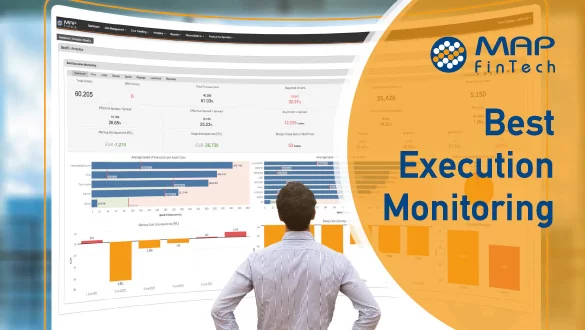
Leverage the power of RegTech Secure your Best Execution Monıtorıng Solution wıth MAP FinTech in September and take advantage of our offer ΜΑΡ FinTech offers a fully automated tool for Best Execution Monitoring. The platform not only satisfies the requirements of financial regulators and MIFID II, but also offers a holistic view of your Best Execution provisions with more than 40 analytical checks applied on all execution components (price, cost, speed, likelihood and settlement, size, price continuity or any other consideration relevant to the order’s execution). Checks include number of orders, percentages, volumes, monetary values, types of orders, types of costs, and benchmarks such as average industry speed, quote delay tolerance, application of charges and more. In addition, the system offers the ability to view complex analytics, input comments, record monitoring and corrective measures, set alerts, and export reports for record-keeping, business and proof of compliance purposes. Take advantage of this limited offer, contract with MAP FinTech during the month of September and get the first two months free! Get the sharpest and most accurate Best Execution Monitoring Solution in the market at the most favourable price. For more information, please fill in the below form and a MAP Fintech representative will contact you soon.
Authorities continue imposing sanctions on Market Abuse

Following ESMA’s annual market abuse report for 2019 which shows that National Competent Authorities (NCAs) and other authorities imposed a total of €88 million related to 339 administrative and criminal actions under the Marker Abuse Regulation (MAR), the Cyprus Securities & Exchange Commission (CySEC) has recently imposed its first ever administrative fine of €40.000 to a CFD/Forex Cyprus Investment Firm (CIF) in relation to MAR. According to CySEC, the said CIF did not maintain effective arrangements and procedures to detect and report suspicious orders and transactions, thus failing to comply with Article 16(2) of MAR. There is no doubt that there has been a significant increase in the number of penalties and enforcements in recent years across the global financial markets in the areas of market abuse. With a growing pressure to detect market abuse, ensuring compliance with MAR continues to be a pressing issue for many firms. It is imperative that firms carry out an in-depth risk assessment of their trading activities to understand and identify when and where they are most at risk of being used to carry out abusive market behaviour, whether this is market manipulation or insider dealing. With a proper understanding and identification of their risk, firms must ensure to implement appropriate trade surveillance systems to monitor and identify any suspicious trading behaviour to reduce the risk of market manipulation and fraud and protect their reputation. The new Market Abuse Regulation came into effect in July 2016. In its new iteration, MAR has significantly extended its scope capturing financial instruments traded on all types of European trading venues and financial products (such as OTC (e.g. CFDs) and on-exchange derivatives) whose price or value is referenced to said financial instruments. Moreover, ‘inside information’ also includes commodities and emission allowances. Recent EU cases have shown that CFD brokers are particularly vulnerable to being used in illegal ‘insider dealing’ activities. For example, in 2018, an online broker in the UK was fined over £1m for failings in its post-trade systems and controls for identifying and reporting suspicious transactions. More specifically, the broker failed to detect two highly profitable CFD trades that potentially used inside information. Our affiliated compliance advisory firm, MAP S.Platis, has published last year an interesting article in relation to Market Abuse and CFD Brokers which can be accessed here https://www.mapsplatis.com/news/ market-abuse-and-cfd-brokers-are-you-doing-enough/. Further to the above, interestingly, EU authorities have recently been contemplating of bringing spot FX contracts into the scope of MAR, albeit, ESMA has, for the time being, decided to postpone the decision on whether to extend the scope of MAR to spot FX contracts. This is an area also worth monitoring especially by CFD/Forex firms. More information about MAR and spot FX contracts can be found in a recent article issued by our analysts https://mapfintech.com/eu-spot-fx-contracts-market-abuse-regulation/. How can MAP FinTech assist you? MAP FinTech’s Trade Surveillance solution provides firms with the tools to monitor all trades and orders to identify potentially suspicious activity and behaviour. It is a comprehensive post-transaction analysis solution to detect suspicious trading activity such as market manipulation and insider dealing in equities, fixed income, foreign exchange, CFDs and other derivatives. The solution is designed to help firms comply with the regulatory requirements of MiFID, MiFIR/MiFID II, MAD/MAR and ESMA Guidelines in Europe, and Dodd Frank, Volcker Rule and MAD in North America. Our services include the technology and the consulting from our experts to provide your firm with a holistic solution for developing and executing a comprehensive and truly risk-based market abuse surveillance programme covering both market manipulation and insider dealing, with superior record-keeping capabilities. For questions or to discuss how MAP FinTech can help your firm strengthen its trade surveillance, increase efficiencies through technology and ensure your regulatory obligations are met, contact our team of experts.
How Can We Maximise Regulatory Technology & Avoid Its Potential Pitfalls? What recent results from the European Banking Authority and ESMA reports show
The European Banking Authority (EBA) has recently published an analysis looking into the RegTech landscape in the EU. The report assesses the many benefits, challenges and risks of the use of RegTech in the EU and lays out the steps to be taken to support the sound adoption and scale-up of solutions in this sector. The study also proposes actions designed to enhance the knowledge and skills of the competent authorities (CAs). ESMA has also published a report on Trends, Risks and Vulnerabilities of the Financial sector dedicating a part on RegTech and SupTech and the change for Markets and authorities. This report highlights that market participants are increasingly using new automated tools in a variety of areas, while potential applications of new tools for regulators include greater surveillance capacity and improved data collection and management. When technology is used for compliance, it is called Regulatory Technology or ‘RegTech’. Regtech is defined as any range of applications of technology‐enabled innovation for regulatory, compliance and reporting requirements implemented by a regulated institution – with or without the assistance of RegTech provider. RegTech solutions in Financial Institutions (FIs) and Investment Firms (FI’s) are currently evident in: Anti-Money-Laundering and Countering the Financing of Terrorism (AML/CFT) – for example, providing solutions for sanction screening or remote onboarding of customers. Fraud prevention – through automated behaviour and transaction monitoring. Prudential reporting – supporting institutions in their regulatory submissions. ICT security – providing detection mechanisms for an institution’s operations security. Creditworthiness assessments – providing new capabilities for assessing the creditworthiness of clients. Regulatory Reporting – supporting institutions in their trade reporting. Risk Management Benefits According to financial organisations using RegTech solutions, their key benefits are improved risk management, better monitoring and sample capabilities, and a reduction in human error. At the same time, RegTech providers place heavy emphasis on their ability to increase efficiency and effectiveness and quell the impact of ongoing regulatory change. Some of the increasing disparities in perspective between financial institutions (FIs) and RegTech providers suggest that further research of the benefits afforded by RegTech solutions is required. ESMA also believes that the move towards a more data-driven and pro-active approach will enhance monitoring of the financial sector and help ensure better outcomes for market participants and consumers. The continual push for efficiencies and cost savings, particularly for back-end and legacy systems as well as for labour-intensive processes will increase the use of RegTech in the foreseeable future. Risks EBA highlighted that when not implemented correctly, RegTech solutions may also generate risks for FIs that would need to be identified, monitored and managed. These risks may relate to, for example, compliance, concentration, business continuity, ICT and security, reputational issues, internal governance, conduct and consumer protection, and/or technology. RegTech may also create new risks for CAs supervising FIs. These include potential difficulties in assessing the effectiveness and reliability of the technological solutions used by FIs, and a potential lack of skills and tools needed to supervise the use of technology enabled RegTech solutions and, say, audit the underlying algorithms. ESMA focused on the risks and challenges for regulators and market participants in the areas of data collection and management, digital transition and failure on the part of market participants to adapt to the new digitalised infrastructure and the need from regulators to invest in the technological tools and human skills that will allow them to effectively analyse the results, operational risks and the risks from strategic incentives such as developing expertise in RegTech. Challenges The EBA report suggests that the majority of challenges to RegTech market development involve internal factors within the FIs and providers. Likewise, ESMA considers most of those challenges to apply for FIs. However, a lack of common regulatory standards across the EU could also constitute a barrier to the wider market adoption of RegTech solutions. The main challenges from the FI perspective are summarısed as follows: Data-related challenges and cybersecurity threats: FIs often indicate data quality, data privacy and protection, lack of data integration, data availability, and lack of data standardisation and harmonisation as issues. Interoperability and integration with the existing legacy systems: FI legacy systems and processes have too many silos, making RegTech adoption difficult, and this is further compounded by doubts about the ICT capacity of FIs to support FinTech, RegTech, and InsurTech solutions. Changes to regulation: changes with national or international regulations and other regulatory challenges can be another key barrier to RegTech adoption. Costs and procurement process: RegTech solutions seen as part of compliance and usually treated as a back‐office function may be at risk of underinvestment. Lack of necessary skills and training: when working with either in‐house or external RegTech solutions, FIs need specialists, e.g. data scientists and engineers, to be able, where relevant, to scout, assess, operate, and maintain updated RegTech solutions. Perceived immaturity of RegTech providers’ solutions: FIs that see RegTech as a potential competitive advantage often cite the lack of available and mature RegTech solutions as a challenge. Challenges from the RegTech provider perspective include: Lack of technological capabilities – the lack of some clients API capabilities and lack of standardisation are perceived as obstacles for technical integration. Security, data privacy and protection issues – privacy regulation may be one of the key constrains for FIs from sharing datasets with RegTech providers. Changes of national and international regulation – complex and continuously evolving regulatory landscape is perceived as a challenge, in particular on prudential reporting, fraud prevention and AML/CFT. Cost of user acquisition – a challenge, especially for recently established and smaller RegTech providers. Lack of FI understanding of RegTech solutions –it appears to RegTech providers that FIs may not be fully aware of all advantages that RegTech solutions may bring. Lack of harmonised legal and regulatory requirements – RegTech providers perceive the lack of harmonisation of regulatory requirements across the EU and the lack of regulatory data standards to be obstacles for wider market adoption of RegTech solutions. Clarity of regulatory/supervisory guidance – RegTech providers consider the lack of regulatory/supervisory
AML monitoring: automate your AML checks and stay compliant
In the past few years, transaction monitoring has become a vital part of anti-money laundering (AML) procedures. All financial institutions need to have some form of transaction monitoring in place to keep an eye out for any suspicious transactions to and from existing customers. Since this requires intensive and thorough assessment, as well as an accurate reporting structure, most organisations prefer the use of an automated system. Why Businesses need AML Transaction Monitoring Software Transaction Monitoring software helps financial institutions track customer transactions in an instant and automate way. It also allows tracking customer transactions that include evaluating past and current customer information and interactions to provide a complete picture of customer activities. The software helps companies comply with the Anti-Money Laundering and Counter Financing of Terrorism regulations. It supports the organisation’s compliance program by detecting suspicious patterns and examining suspicious transfers and transactions in digital currencies. Why is transaction monitoring software important? There are many reasons for financial service companies to implement AML transaction monitoring software. In the digital world we live in, the number of electronic financial transactions has increased enormously. As a result, money laundering activities are increasing, so AML transaction monitoring analytics is in higher demand than ever. AML compliance regulations and transaction monitoring play also a key role in detecting increasingly complex financial criminal activity. It can detect suspicious activities such as large cash deposits or wire transfers, thus, allow organisations to spot financial crimes before they happen or very early on. The growth of various electronic payment instruments and the reduction of cash payments mean a much higher transaction volume that AML technology systems should monitor. If financial institutions choose to scan this data for manual monitoring, this will be incredibly time-consuming and error-prone, adversely affecting the customer experience. Moreover, when financial institutions detect suspicious transactions and they report them to the authorities, regulators ask for evidence. The AML software proactively recognizes suspicious transactions, which leads to the correct presentation of suspicious activity reports (SAR). Transaction Monitoring can help companies provide evidence to regulators, auditors, and other stakeholders about the program’s operation. Do all financial firms require Transaction Monitoring solutions? Many firms will consider transaction monitoring to be a crucial element in their fight against financial crime, which is further highlighted in both regulation and industry guidance. Transaction monitoring is the most effective way to help financial institutions comply with AML and Counter Financing of Terrorism regulations. Often, it can be a mandatory step to fulfil your AML obligations of continuous due diligence regarding customers and their operations. While it is not legally required worldwide for financial institutions to have transaction monitoring in place, not having one could settle an organization in a lot of trouble. A fundamental part of taking a risk-based approach is the continuous monitoring of clients. Failing to have such a system in place can not only cost a financial institution its reputation, but it can also lead to large fines and other penalties. What is more, transaction monitoring is not enough. AML monitoring of transactions is an integral part of any AML policy. Usually, financial institutions employ a combined risk prevention solution to customer accounts — an all-round AML check. How MAP FinTech can assist MAP FinTech’s KYC and AML Transaction Monitoring Solution is a complete Client Lifecycle Management Solution which streamlines all your day-to-day compliance operations, from Onboarding to client acceptance, transaction monitoring and screening, detecting suspicious activity and managing investigations. A risk-based approach that fits your KYC AML requirements The approach of risk evaluation and assessment is different depending on the regulator and the jurisdiction in which your organisation operates. Our solution delivers a comprehensive, automated risk assessment to fit your industry, business model, customer base, products and services, distribution channels, regulatory environment, and risk appetite. Our flexible and scalable platform is ideal for performing Risk Assessment for financial institutions, gaming, ICOs, shipping and marine trading organisations. Benefits: Centralised solution Complete Client Profile Compliance Repository Case Repository Clever Technology Seamless Onboarding Ongoing Monitoring Minimises False Positives Multi-jurisdiction markets Workflow engine Effortless Implementation Highly configurable API Easy integration of client profile Easy migration Machine learning and AI driven Ongoing Support Team of expert professionals Personalised support for all clients, leading to longstanding co-operation
Missed the deadline for CRS and FATCA reporting obligation?

It is better late than never! MAP FinTech can fully support and assist with your CRS & FATCA reporting needs. We receive reportable information, construct the CRS and FATCA annual reports, and, for most countries, submit them to the relevant competent authority as prescribed by the relevant provisions of CRS and FATCA. ΜΑΡ FinTech’s CRS and FATCA Reporting Services provide a user-friendly approach to receiving, validating, transforming and submitting the relevant information required under the CRS/FATCA reporting and due diligence rules. These services are delivered via our powerful and award-winning Polaris platform, together with the rest of its reporting offerings and our team of experts’ impeccable support services. ΜΑΡ FinTech’s CRS/FATCA – Key Features Cost-efficient integrated reporting solutions provided under a single platform. Highly automated and scalable solution that can report as many accounts as you have. Flexible in the way it receives data, either via standard templates or raw data. Multiple reporting health checks for both content and schema and automatic filtering of erroneous entries. Automatic conversion of data to XML and separation of files based on tax residency. Submissions to various tax authorities worldwide. On-going communication with regulators to ensure the system reports reflect regulatory updates and changes. About MAP FinTech Complyport.tech is a leading award-winning UK and EU regulatory technology provider for the financial services industry, specialising in reporting solutions arising from the requirements of a number of complex and challenging international regulations such as EMIR, MiFID II/MiFIR, ASIC, SFTR, FATCA, DAC6 and CRS. MAP FinTech also provides innovative and comprehensive solutions for Best Execution Monitoring, RTS 27/28 reporting, KYC & AML Transaction Monitoring, Trade Surveillance (Market Abuse), and eKYC (Screening, eIDV, Document Authentication). If you would like to receive more information about our CRS and FATCA Reporting Services, or you need assistance with your CRS and FATCA reporting requirements, please do not hesitate to contact our expert team.
Best Execution Monitoring. Leverage the power of RegTech!
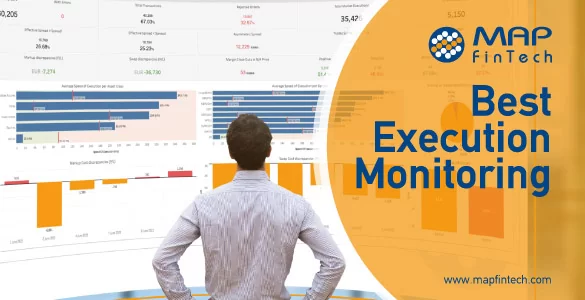
While Best Execution obligations are not new, there have been important changes since its introduction in MiFID I in 2007. With the launch of MiFID II in 2018, there was a change from reasonable to sufficient steps that should be taken by investment firms to ensure that they obtain the best possible result for clients when executing orders. This change has set a higher bar for compliance. Moreover, MiFID II requires that investment firms monitor the effectiveness of their order execution arrangements and execution policy to identify and, where appropriate, correct any deficiencies. Additionally, firms must be able to demonstrate to their clients that they have executed their orders in accordance with the investment firm’s execution policy and demonstrate their regulatory compliance to competent authorities. Implications for Relevant Firms To ensure Best Execution compliance, firms should conduct monitoring to establish whether their execution of transactions delivers the best possible result for the client. This has to take into account factors like: Price Cost Speed Likelihood of execution Settlement, size and nature Any other consideration relevant to the execution of an order Weighting of these factors should be dependent on the client’s categorization (i.e. retail, professional etc.) Monitoring can be performed either with manual checks using spreadsheets or by using regulatory technology solutions from providers who specialize on regulatory compliance. Why use RegTech? Avoid human errors. Manual monitoring is not always accurate due to human error; hence it is less reliable. Automated testing performed by software uses algorithms, which ensures accuracy and consistency. Save time and resources. Monitoring Best Execution manually is time consuming and may not be an efficient use of a compliance team’s abilities. Using an automated solution can speed up the monitoring process, consequently saving time and work hours and giving compliance staff increased time to spend on more complex tasks which need a ‘human touch’. Frequent and continuous monitoring. Manual monitoring is only practical for tests run periodically, where frequent repetition is not required. Automated testing is the most practical option when tests need to be frequent and continuous (as is the regulatory obligation under MiFID II.) Monitor all activity. An automated solution will facilitate the monitoring of all company activity with capabilities, storage availability, and timeless calculations not feasible when using spreadsheets. Additionally, it can offer considerably more checks than would be feasible for staff conducting manual best execution monitoring. Avoid inadequate or insufficient sampling. Inadequate or insufficient sampling can lead to poor monitoring not aligned with the regulator’s expectations. By automating your monitoring, you avoid the risk of sampling transactions you need to monitor, where many conditions need to be met. Track statistics, metrics, and benchmarks. The right regulatory technology will allow compliance teams to obtain and present monitoring results, statistics, and metrics that can be used to identify areas for improvement and give a ‘big picture’ view of your execution quality. In addition, this can lead to the creation and use of benchmarks to compare your best execution quality to either external verifiable sources or an industry average. This is much more difficult to facilitate through only manual monitoring. Improved record keeping capabilities. Using Best Execution software can allow compliance teams to store all tests, transactions, statistics, comparisons, and any deficiencies identified for future use, either for providing the regulator with proof of monitoring or for record keeping purposes. Effective complaints investigations. Monitoring software makes it easier to find and investigate specific transactions in the event of a complaint about a firm’s Best Execution practices. The extensive detail and record-keeping capacity of regulatory technology can lead to better-informed complaint handling and improved records of any investigations for future reference or inspection. How can Complyport Tech assist? Complyport Tech offers a fully automated tool for Best Execution Monitoring. The platform not only satisfies the requirements of financial regulators and MIFID II, but also offers a holistic view of your Best Execution provisions with more than 40 analytical checks applied on all execution components (price, cost, speed, likelihood and settlement, size, price continuity or any other consideration relevant to the order’s execution). Checks include number of orders, percentages, volumes, monetary values, types of orders, types of costs, and benchmarks such as average industry speed, quote delay tolerance, application of charges and more. In addition, the system offers the ability to view complex analytics, input comments, record monitoring and corrective measures, set alerts, and export reports for record-keeping, business and proof of compliance purposes.
Complyport Tech features in the Planet Compliance Report highlighting 30 of the most dynamic RegTech firms.
Planet Compliance has recently launched its 2021 RegTech Directory, profiling 30 of the most dynamic RegTech firms. Complyport Tech is proud to be featured along with some of the top RegTech firms globally! Download your free copy here. Click below to read our profile and interview on pages 72-75.
Complyport Tech wins Best Innovative Technology for Regulatory Compliance award at the RegTech Insight Awards 2021
Complyport Tech, a leading and award-winning regulatory technology provider, is excited and honoured to announce that it has received the award for Best Innovative Technology for Regulatory Compliance at the RegTech Insight Awards 2021. The RegTech Insight Awards recognise RegTech solutions developed by both established solution providers and innovative newcomers that have successfully improved firms’ ability to respond to the evolving and increasingly complex regulatory requirements found in the financial services industry. Panayiotis Omirou, CEO of Complyport Tech, said: “We are always very proud when the market selects us for an award. This recognition highlights our deep expertise and innovative solutions, which allow our clients to simplify compliance and efficiently manage their onerous regulatory requirements. We will continue to combine the compliance and technology functions, so that we remain flexible, efficient and effective when supporting the many new, demanding and dynamic requirements of the global RegTech world.” Angela Wilbraham, CEO of A-Team Group, said: “Many congratulations to Complyport Tech for winning Best Innovative Technology for Regulatory Compliance in our prestigious RegTech Insight Awards 2021. It’s a real vote of confidence from across our readership of 30,000 senior technology officers and data specialists, who selected Complyport Techas the clear winner in a very competitive field”.